
Executive Piano Series presents: Fanya Lin in concert
April 18 @ 3:00 pm
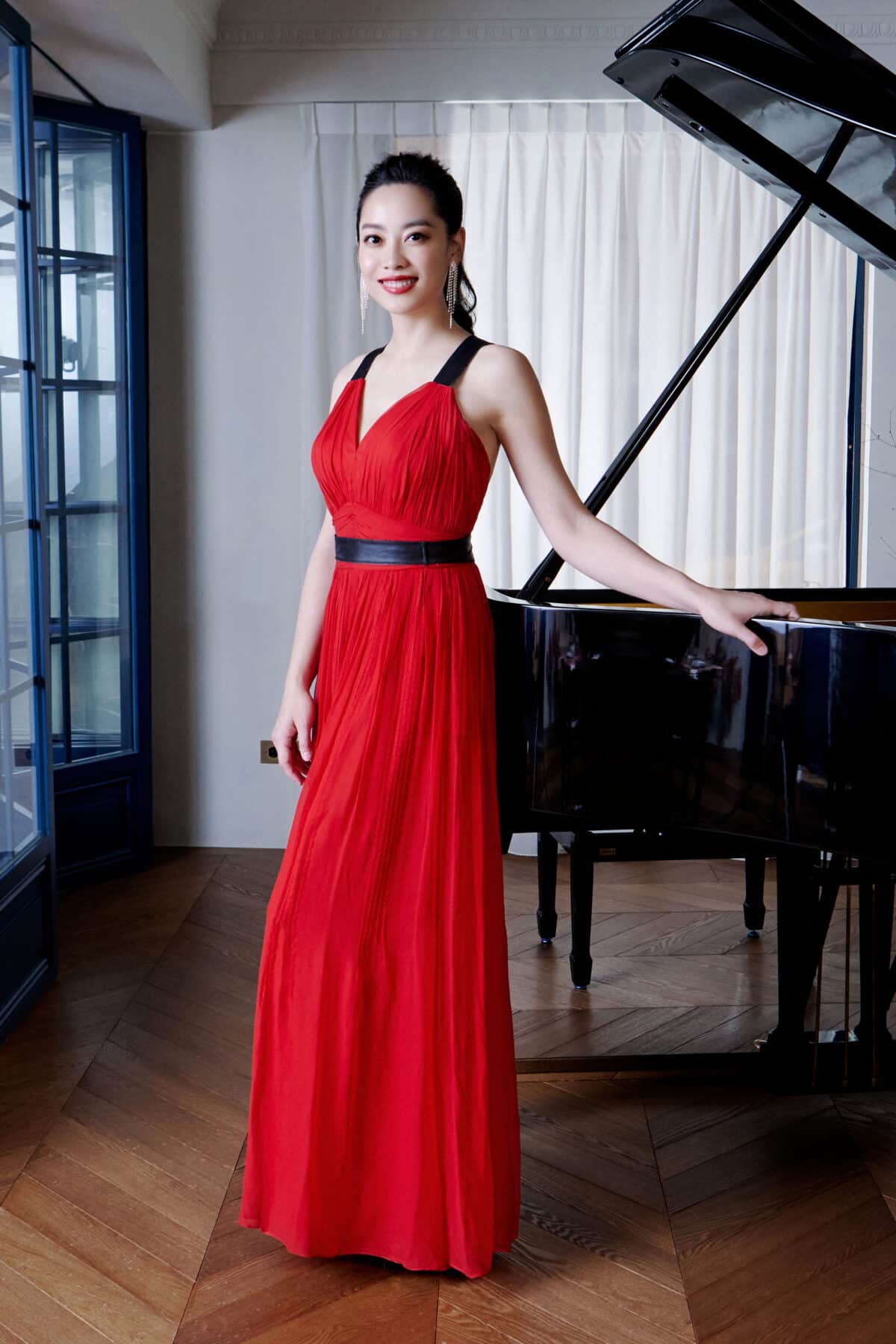
Described as a “striking interpreter” who gives a “committed and heartfelt performance” by Musical America and The New York Times, Steinway Artist Fanya Lin has entranced audiences worldwide with her charismatic and fiery performances. Her orchestral appearances include the Royal Philharmonic Orchestra (UK), Toruń Symphony (Poland), Orquestra Sinfônica do Rio Grande do Norte (Brazil), New Art Symphony (Taiwan), Hiroshima Tafel Orchestra (Japan), Flagstaff Symphony (US), among others. Her concerto album Rhapsodic featuring Gershwin’s Rhapsody in Blue and Rachmaninoff’s Rhapsody on a Theme of Paganini with Maestro Theodore Kuchar and the Lublin Philharmonic was selected as Textura’s “Top 20 Classical Picks” and won 2nd Prize for the Petrichor Records’ Best Album Award in 2024.
Lin’s upcoming recital titled Metamorphosis features the thematic variations and transformation in piano repertoire, including Johannes Brahms’s Chorale Prelude Op. 122 No. 10; Taiwanese composer Yi-Chih Lu’s Dark Sky; three preludes from polish composer Karol Szymanowski’s Op. 1; Bach-Busoni Chaconne in D minor; and the monumental B minor sonata composed by Franz Liszt.
The Metamorphosis program opens with Johannes Brahms’s Chorale Prelude Op. 122 No. 10, Herzlich tut mich verlangen, transcribed by pianist Ferruccio Busoni. Originally composed during the last year of Brahms’s life in 1897, the Eleven Chorale Preludes are among his most intimate works. Written for organ, they distill a lifetime of compositional mastery into music of quiet gravity and spiritual depth. Herzlich tut mich verlangen (“My heart is filled with longing”) is a meditation on sorrow, consolation and faith. They were written during Brahms’ visit to Ischl, where Brahms had vacationed annually from 1889, but his final visit was clouded by Clara Schumann’s recent death in May 1896, as well as Brahms’ own health battle with liver cancer.
From the last note of Herzlich tut mich verlangen, we dive into a completely different world constructed by Taiwanese composer, Yi-Chih Lu, threaded by the same key and the ending and opening notes of the two pieces. The thematic material of Dark Sky was drawn from the Taiwanese folk tune with the same title, depicting the subtropical rainy season of Taiwan, the fisherman’s anxiety toward the bad weather and the quarrel between an old couple. In Yi-Chih Lu’s transcription of Dark Sky, the thematic material was mingled with Prokofiev’s rhythm, a vintage form of fugue and the Rachmaninoff ending.
Karol Szymanowski (1882–1937) stands as one of the most significant Polish composers of the 20th century, reflecting the major musical currents of his time. Initially influenced by Chopin and Wagner, his music draws from a wide range of inspirations of European traditions, while incorporating exotic elements of Oriental culture. Closely connected to the piano throughout his life, Szymanowski composed for the instrument from his earliest years to his final works. Although many early piano pieces have been lost, he emerged at age eighteen with the Nine Preludes, a work that immediately impressed audiences and critics. Shaped by Chopin’s models yet infused with intense youthful emotionalism, the Preludes reveal Szymanowski’s distinctive voice through rich harmonic language, polyrhythms and emotionally charged climaxes that already anticipate the innovations of Scriabin. The three preludes selected today are in B minor and D minor, foreshadowing the remained two pieces in the program.
The first half of the concert comes to an end with the return of yet another transcription of Busoni. Ferrucio Busoni displayed a passion for Bach at an early age. He made an exhaustive study of Bach’s music and throughout his adult life worked tirelessly at editing and making transcriptions of works by the Baroque master. The transcription of Chaconne from Bach’s Partita No. 2 for solo violin was made sometime in the late 1890s and was dedicated to the pianist Eugene d’Albert; Busoni himself played it frequently on his own blazingly brilliant recitals. The Chaconne was originally the final movement of the Bach’s Violin Partita No.2, a set of more than 60 variations on a simple bass theme. Busoni tried to remain as close to the original as possible while adapting the music to suit the technical possibilities of the piano. Sound wise, he sometimes oriented himself on orchestral colours or organ registers, which echoes with the transcription of Brahms’ Eleven Chorale Preludes originally written for Organs.
Franz Liszt’s Sonata in B minor (1853) stands as one of the most groundbreaking works of the nineteenth-century piano repertoire, redefining large-scale musical form through unity and thematic transformation. Cast in a single continuous movement of approximately thirty minutes, the sonata encompasses the expressive and structural functions of a traditional sonata-allegro form, while integrating a group of motives introduced at the opening that unfolds throughout the entire composition. Structurally, the sonata begins with a dark, ominous introduction that leads into an expansive exposition, while the same violent theme then turns into the most beautiful, tender and surreal second thematic area. The middle section of Andante sostenuto and Quasi Adagio can be regarded as the development or the 3rd movement of a five-movement work, then to return to the Fugue in Allegro energico. The second thematic area then comes back in a different key. The piece finally ends with the return of the slow development section, contrary to Liszt’s traditional loud and explosive endings, the sonata shares the reflective and introspective atmosphere as if paying a tribute to Beethoven’s late period work or Schumann’s Op. 17.
For more information:
https://executivepianoseries.com